From "Vibing" to Velocity: Why AI is an Exoskeleton for Senior Engineers
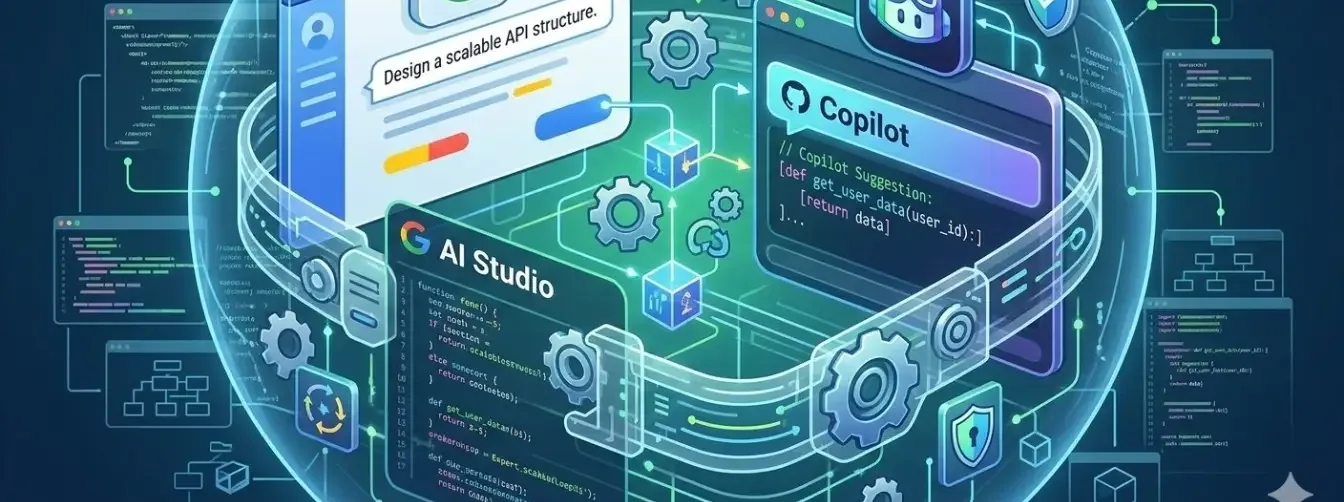
In my last post, I poked some well-deserved fun at the "vibecoding" trend—the dangerous illusion that anyone with a prompt can build a production-ready system. But let's be clear: the problem isn't the AI. The problem is the operator.
For a senior developer, tools like GitHub Copilot and Google AI Studio aren't magic wands; they are high-performance engineering exoskeletons. When you already understand the "why," these tools remove the friction from the "how."
1. The Death of the Boilerplate Tax
An experienced dev knows exactly how to write a standard Express.js middleware, a React custom hook, or a Python data processing script. Writing it for the 100th time doesn't add value; it just consumes cognitive load.
GitHub Copilot excels at "intent-to-implementation." By establishing a pattern in the first ten lines of a file, you've essentially "trained" Copilot on your style. It handles the repetitive syntax (the boilerplate) while you focus on the unique business logic.
Result: You stay in a flow state for hours because you aren't constantly context-switching to look up minor API signatures.
2. Google AI Studio: The 1-Million Token Sandbox
While Copilot is your co-pilot during the act of typing, Google AI Studio (using the Gemini Flash models) is your architectural consultant.
Codebase Interrogation: With its massive 1M+ token context window, you can upload an entire legacy repository or a massive SDK documentation. You aren't "vibing" anymore; you're asking technical questions: "Where are the potential race conditions in this specific event-handling loop?" or "Draft a migration path from this v2 API to v3 using the attached documentation."
Rapid Prototyping (With Guardrails): A senior dev uses AI Studio to generate three different architectural approaches to a problem in seconds. They then use their experience to pick the one with the lowest technical debt.
3. The Professional vs. The Novice: A Comparison
The difference in value comes down to how the tool is integrated into the SDLC (Software Development Life Cycle).
FeatureThe "Vibecoder" ApproachThe Senior Dev ApproachLogicAccepts the first suggestion that "runs."Audits logic for O(n) complexity and edge cases.SecurityOblivious to SQL injections or leaky APIs.Prompts specifically for secure patterns (e.g., parameterized queries).TestingSkips tests because "it looks like it works."Uses AI to generate a Unit Test Matrix for maximum coverage.MaintenanceCreates a "Black Box" no one can fix.Uses AI to document the architecture they designed.
4. Learning at the Speed of Light
Even for experts, technology moves fast. If you are a backend specialist forced to touch a Vue.js frontend for the first time in three years, AI is your dialect translator. You understand the concepts (state management, component lifecycles, props); the AI just helps you find the current syntax without spending three hours in the documentation.
The Verdict: Thinking vs. Typing
AI-assisted development is about moving the bottleneck. For years, the bottleneck was how fast we could type and find information. Today, the bottleneck is back where it belongs: how well we can design and solve problems.
If you are an experienced developer and you aren't using these tools, you are essentially choosing to dig a ditch with a shovel while your peers are using excavators. Just remember: the excavator only works if you know where the gas pipes are buried.