The Microwave "Chefs" of the AI Revolution
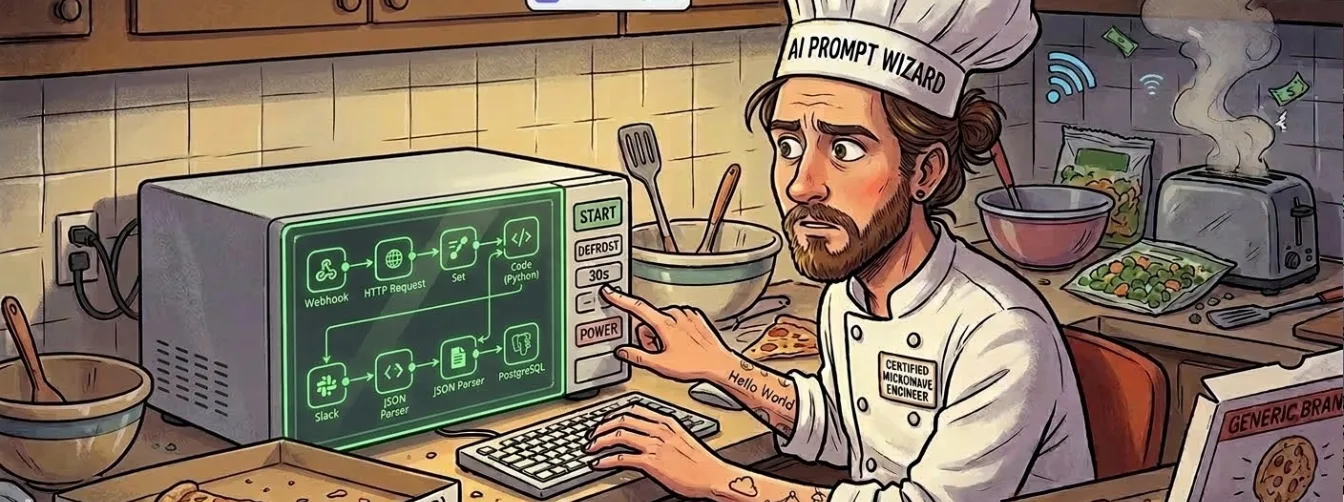
If you've spent more than five minutes on social media lately, you've seen them. The "AI Alchemists," the "Prompt Wizards," and the "Automation Gurus." They're selling courses that promise to turn you into a tech powerhouse in six weeks—all for the low, low price of your dignity and a few hundred dollars.
But let's peel back the shiny foil on these "masterclasses."
Selling the Frozen Pizza
Imagine walking into a prestigious culinary academy. You've paid your tuition, sharpened your knives, and you're ready to learn the secrets of a perfect Béarnaise or the chemistry of sourdough.
Then, the instructor walks in, pulls a $3 frozen pizza out of a cardboard box, slides it into a microwave, and hits "Defrost."
"Behold," they say. "You are now a Michelin-starred chef. That'll be $499, please."
This is exactly what the current invasion of AI courses is doing. They aren't teaching you "computer science," "data architecture," or "software engineering." They are teaching you how to use a microwave to heat up pre-packaged logic that someone else (OpenAI, Google, Meta) actually cooked.
The "Prompt Engineer" Delusion
These courses focus almost entirely on the interface, never the infrastructure.
-
The Course Teaches: "How to write a prompt that generates a landing page."
-
Real Engineering Requires: Understanding responsive design, SEO, accessibility, state management, and why a specific CSS framework was chosen over another.
In their world, "engineering" is just knowing which buttons to press. They treat the LLM like a magic box that replaces knowledge, rather than a tool that augments it.
Look Mom, a Stripe Notification! (The Bait)
Of course, no microwave-chef-turned-AI-masterclass-seller would be complete without the bait. You've seen the screenshots:
-
A phone background that's just a blurred pile of $100 bills.
-
The obligatory graph showing "revenue" (not profit, never profit) going straight up.
-
And the classic: A perfectly timed photo of a Stripe notification showing a payment for $1,200, with the caption: "Just made this while taking a nap using my AI micro-SaaS!"
This is the psychological hook. They want you to believe that "software" is a passive income vending machine, and their $299 course is the quarter you need to activate it.
The reality they conveniently ignore? That Stripe notification isn't from an app that someone is paying to use. It's from another person who just bought the course. They aren't selling software; they are selling a dream of selling software to people who don't know how to build software. It's a fractal of microwave pizzas, all the way down.
Why the Microwave Eventually Fails
A microwave is great when you're in a rush and need something "good enough." But you can't run a 5-star restaurant with ten microwaves and a Costco membership.
When a business relies on "microwave chefs"—people who have only learned to prompt their way through problems—they hit a wall the moment the "frozen pizza" doesn't fit the tray.
-
No Customization: If the AI output has a bug, the microwave chef is stuck. They can't fix the ingredients; they can only hit "start" again and hope for a different result.
-
Nutritional Value (Quality): AI-generated code from a non-developer is often "empty calories." It looks like an app, but it lacks the security, scalability, and performance of a hand-crafted codebase.
-
The Cleanup: Eventually, the microwave catches fire. That's when they have to call a real chef (a developer) to come in, throw out the charred remains, and actually clean the kitchen.
Don't Buy the Hype, Buy the Ingredients
The irony is that tools like Google AI Studio and **GitHub Copilot **(and many others) are incredible industrial-grade ovens. In the hands of a real chef, they allow for incredible speed and creativity.
But no tool can replace the fundamental understanding of how "heat" (logic) affects "food" (data).
If a course promises to make you a "Developer" without teaching you a single line of actual code, save your money. You aren't learning to cook; you're just learning how to read the instructions on the back of the box. And in the world of professional software, "Good Enough" is rarely good enough for long.